Beyond Impressions: Why Outcome-Based Ads Define Modern Campaigns
The End of Vanity Metrics in Political Advertising
For decades, the benchmark for a successful political advertising campaign was reach and frequency. The goal was simple: get the candidate’s name and message in front of as many eyeballs as possible, as often as possible. Success was measured in impressions—a raw count of ad views that said little about actual voter impact. In today’s hyper-competitive, data-driven environment, this model is obsolete. Simply being seen is no longer enough. Winning campaigns are now defined by their ability to drive measurable outcomes.
The strategic shift from impressions to outcomes represents a fundamental change in how campaigns allocate resources, measure success, and ultimately, persuade voters. For conservative campaigns built on principles of fiscal responsibility and strategic efficiency, this evolution isn’t just an option—it’s a necessity. It’s time to move beyond vanity metrics and focus on what truly matters: turning ad dollars into donations, volunteers, and votes.
From Passive Views to Active Engagement
An impression-based strategy treats all ad views as equal, whether the viewer immediately scrolled past or watched the entire message. This approach fails to answer the most critical questions for a campaign manager: Did the ad persuade anyone? Did it inspire a donation? Did it add a name to our volunteer list? Without answers, millions can be spent on ads that generate awareness but fail to build a movement.
Outcome-driven advertising, by contrast, measures success based on specific, tangible actions taken by the viewer after seeing an ad. These key performance indicators (KPIs) become the new standard for victory:
- Lead Generation: Capturing email addresses and phone numbers to grow the campaign’s supporter list.
- Fundraising: Tracking the number of donations and the total revenue generated from an ad set.
- Volunteer Sign-ups: Measuring how many supporters commit to making calls, knocking on doors, or hosting events.
- Event RSVPs: Quantifying interest and attendance for rallies, town halls, and digital events.
This approach is powered by tracking technologies like the Meta Pixel and Google conversion tags. By placing these snippets of code on key pages of a campaign website—such as donation confirmation pages or volunteer sign-up forms—campaigns can directly attribute user actions back to the specific ads that drove them.
The Conservative Advantage: Accountability and Efficiency
Adopting an outcome-based model offers distinct advantages that align directly with conservative principles. It transforms ad spending from a speculative art into a data-backed science, ensuring every dollar is held accountable for its performance.
Key Metrics for the Modern Campaign
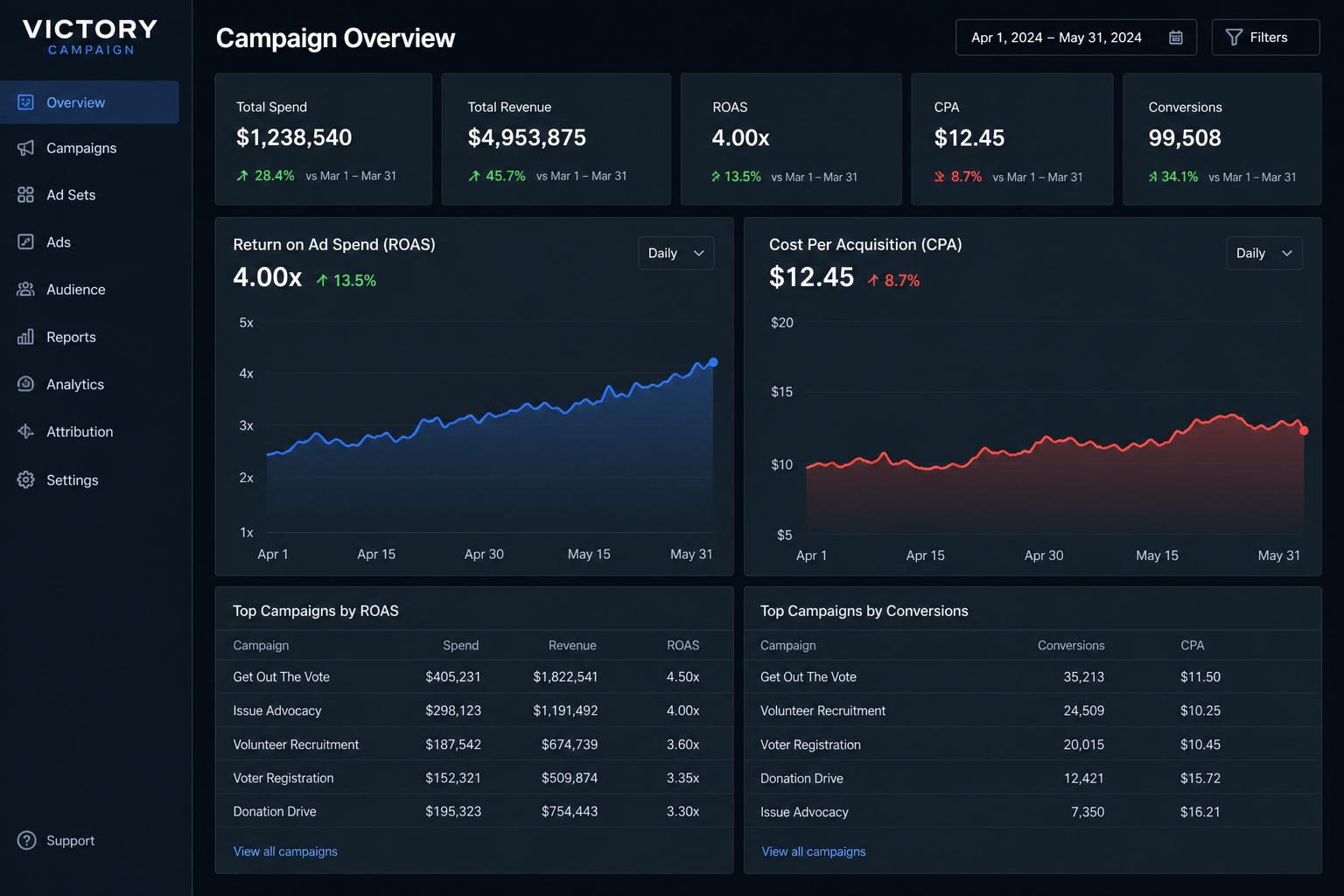
Instead of just looking at impressions and clicks, sophisticated campaigns now live and die by two primary metrics:
- Cost Per Acquisition (CPA): This metric calculates the exact cost to acquire a desired outcome. For example, if you spend $500 on ads and get 50 new email sign-ups, your CPA for a new lead is $10. This allows you to benchmark performance and identify your most efficient messaging and targeting strategies.
- Return on Ad Spend (ROAS): Primarily used for fundraising, ROAS measures the revenue generated for every dollar spent on advertising. A ROAS of 3x means that for every $1 you spent, you raised $3 in donations. This metric is the gold standard for proving the financial viability of a digital fundraising program.
This focus on measurable returns ensures that donor funds are used as effectively as possible. It enables campaigns to cut wasteful spending on underperforming ads and double down on creative and targeting combinations that are proven to work. This isn't just smart marketing; it's a demonstration of responsible stewardship that resonates deeply with a conservative base.
Implementing an Outcome-Focused Strategy
Transitioning from an impression-based to an outcome-based mindset requires a disciplined, strategic approach. It’s not about abandoning awareness but about ensuring that awareness is a stepping stone to action.
1. Establish Your Technical Foundation
Proper tracking is non-negotiable. Ensure that conversion tracking pixels are correctly installed on every critical page of your website. Integrate your ad platforms with your CRM and donation processor to create a seamless flow of data. Without this infrastructure, you are flying blind.
2. Define Clear and Segmented Goals
An ad designed to raise money should look different and be measured differently than an ad designed to capture email leads. Create separate campaigns for each of your primary objectives—fundraising, list-building, persuasion—and tailor your creative, copy, and call-to-action accordingly. Judge each campaign only by its relevant outcome metric.
3. Test, Analyze, and Iterate Relentlessly
The beauty of outcome-based advertising is the immediate feedback loop. A/B test everything: different images, video clips, ad copy, headlines, and target audiences. Monitor your CPA and ROAS in real-time. When you find a winning combination, scale the budget. When an ad fails to perform, turn it off and reallocate those funds to a better performer. This agile approach allows you to constantly refine your message and maximize your impact.
Winning the Margin With Data
In a tight election, victory is decided on the margins. The campaigns that can most efficiently acquire new supporters, raise funds, and turn out their voters will have the decisive edge. The shift from impressions to outcomes is more than a technical adjustment; it is a strategic imperative. By embracing the accountability, efficiency, and intelligence of outcome-driven advertising, conservative campaigns can ensure their message not only reaches voters but moves them to action.