The Conservative Guide to Voter Personalization at Scale
The Era of Impersonal Mass Messaging Is Over
For years, the gold standard of digital campaign outreach was a mass email that began with “Dear [First Name].” While a basic mail merge was once a novel touch, today’s voters are digitally fluent and inundated with messaging. They can spot generic, one-size-fits-all communication from a mile away. Simply using a supporter’s name is no longer enough to build the trust and connection required to win elections. In a landscape saturated with noise, the campaigns that cut through are those that communicate with voters as individuals, not as entries on a list.
True personalization goes far beyond a name tag. It is the practice of using data to understand a voter’s specific interests, values, and concerns, and then tailoring messaging to reflect that understanding. According to research from McKinsey & Company, 71% of consumers expect companies to deliver personalized interactions. This expectation doesn’t disappear in the political arena. Voters want to feel seen and heard, and data-driven personalization is the most scalable way to achieve that.
What Is True Campaign Personalization?
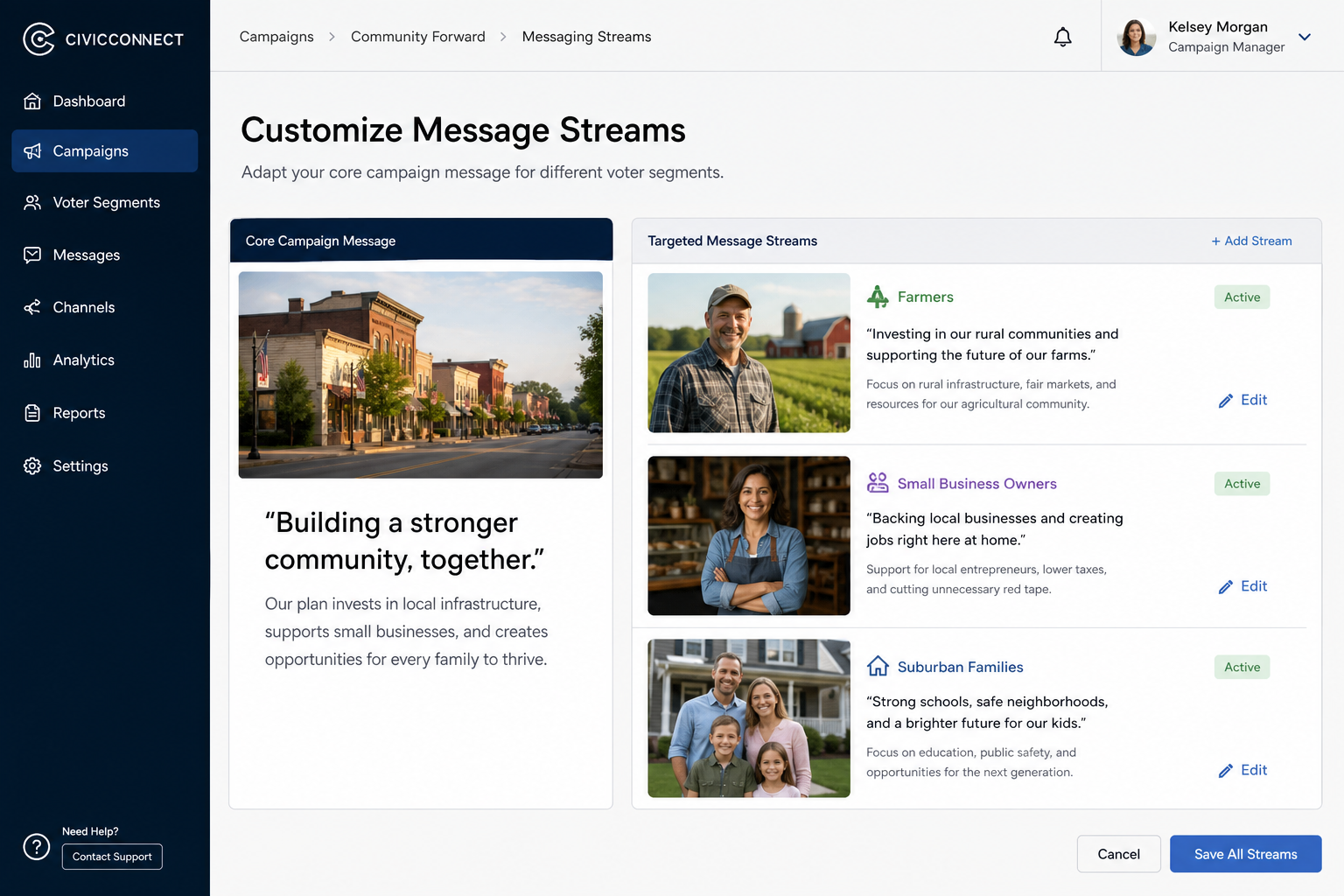
At its core, personalization is about relevance. It means sending a small business owner an email about deregulation and tax policy, not a generic get-out-the-vote blast. It means showing a suburban mother a digital ad about school choice and parental rights. It is a strategic approach that segments audiences based on a rich set of data points and delivers content that resonates with each segment’s unique priorities.
This requires moving from a broadcast model—sending one message to everyone—to a targeted model that relies on several key components:
- Voter Segmentation: Dividing your audience into distinct groups based on shared characteristics. This can include demographics (age, location), psychographics (values, lifestyle), past behavior (donation history, event attendance), and issue alignment (pro-Second Amendment, fiscal conservative).
- Data-Informed Messaging: Crafting message variants that speak directly to the concerns of each segment. The core campaign platform remains the same, but the angle and proof points are customized.
- Dynamic Content Delivery: Using technology to automatically serve the right message to the right person across multiple channels, including email, social media, and your campaign website.
Building the Data Foundation for Personalization
Effective personalization is impossible without a robust data infrastructure. This is not about guesswork; it is about systematically collecting, organizing, and activating voter information. A modern campaign’s data ecosystem should be built on a powerful Customer Relationship Management (CRM) platform that serves as the central hub for all voter interactions.
Data can be gathered from numerous sources:
- Voter Files: Publicly available records that provide a baseline of demographic information.
- First-Party Data: Information collected directly from supporters through website sign-ups, event registrations, surveys, and donation forms. This is the most valuable data a campaign can possess.
- Engagement Data: Tracking how supporters interact with your campaign, such as which emails they open, which links they click, and which social media posts they engage with.
By integrating these sources, campaigns can build detailed voter profiles that enable sophisticated segmentation and targeting. This foundation allows a campaign to identify, for example, a subset of voters who are registered Republicans, have donated in the past, and have clicked on links related to border security.
Strategies for Conservative Campaigns to Implement Personalization
For conservative campaigns, personalization offers a powerful way to bypass hostile media narratives and speak directly to voters about the issues they care about most. It allows us to reinforce our commitment to individual liberty and community values by treating each voter with the respect of a personalized conversation.
1. Dynamic Email and SMS Content
Modern email and texting platforms allow for the creation of dynamic content blocks. This means a single email can be built with multiple message variations, and the platform will automatically display the block most relevant to each recipient. For instance, a fundraising appeal can feature a paragraph about agricultural policy for rural voters and a different one about supporting law enforcement for suburban voters—all within the same email send. This increases relevance and response rates without multiplying the team’s workload.
2. Hyper-Targeted Digital Advertising
Platforms like Facebook and Google allow for custom audience targeting. By uploading segmented lists from your CRM, you can run ad campaigns that speak with precision. A campaign could serve ads highlighting the candidate’s pro-life stance to an audience of self-identified evangelicals, while simultaneously running ads about reducing government spending to a segment of fiscally conservative independents. This ensures ad dollars are spent efficiently, reaching the most receptive audiences with the most resonant message.
3. Customized Website and Landing Page Experiences
Advanced campaigns can even tailor their website content. A user arriving on a donation page from an email about national security could see a headline that reads, “Help Us Fund the Fight for a Strong America.” Another user, arriving from a social media post about education, might see, “Invest in Our Children’s Future.” This seamless continuity from outreach to action reinforces the message and boosts conversion rates.
The Future Is Personal
In a deeply divided and noisy political environment, the ability to build genuine connections is a campaign’s greatest asset. Personalization at scale is no longer a futuristic concept; it is a present-day strategic imperative. Conservative campaigns that invest in the data infrastructure and creative strategy to communicate with voters as individuals will not only improve their fundraising and engagement metrics but also build a more resilient and loyal coalition of supporters. By respecting voters enough to speak to their specific concerns, we demonstrate the very principles we champion: a belief in the power and importance of the individual.