Beyond the General Consultant: Building a Modern Campaign SWAT Team
The Old Guard: The Age of the General Consultant
For decades, the dominant model in political campaign management was straightforward: hire a General Consultant (GC). This single firm, or a well-connected individual, served as the campaign’s brain trust, making top-level strategic decisions and managing nearly every operational component, from media buys and direct mail to polling and digital outreach. The logic was sound—a centralized command structure ensures message discipline and simplifies decision-making for the candidate. The GC was the architect, and every other vendor was a subcontractor executing that vision.
However, the rapid fragmentation and specialization of the digital landscape have exposed the limitations of this monolithic approach. A firm that built its reputation on masterful television ad production is unlikely to possess the same level of expertise in programmatic digital advertising or SMS-based fundraising. In today’s environment, the jack-of-all-trades is a master of none, and campaigns that rely on the old model often pay a premium for mediocre, bundled services.
The Shift: The Rise of the Specialists
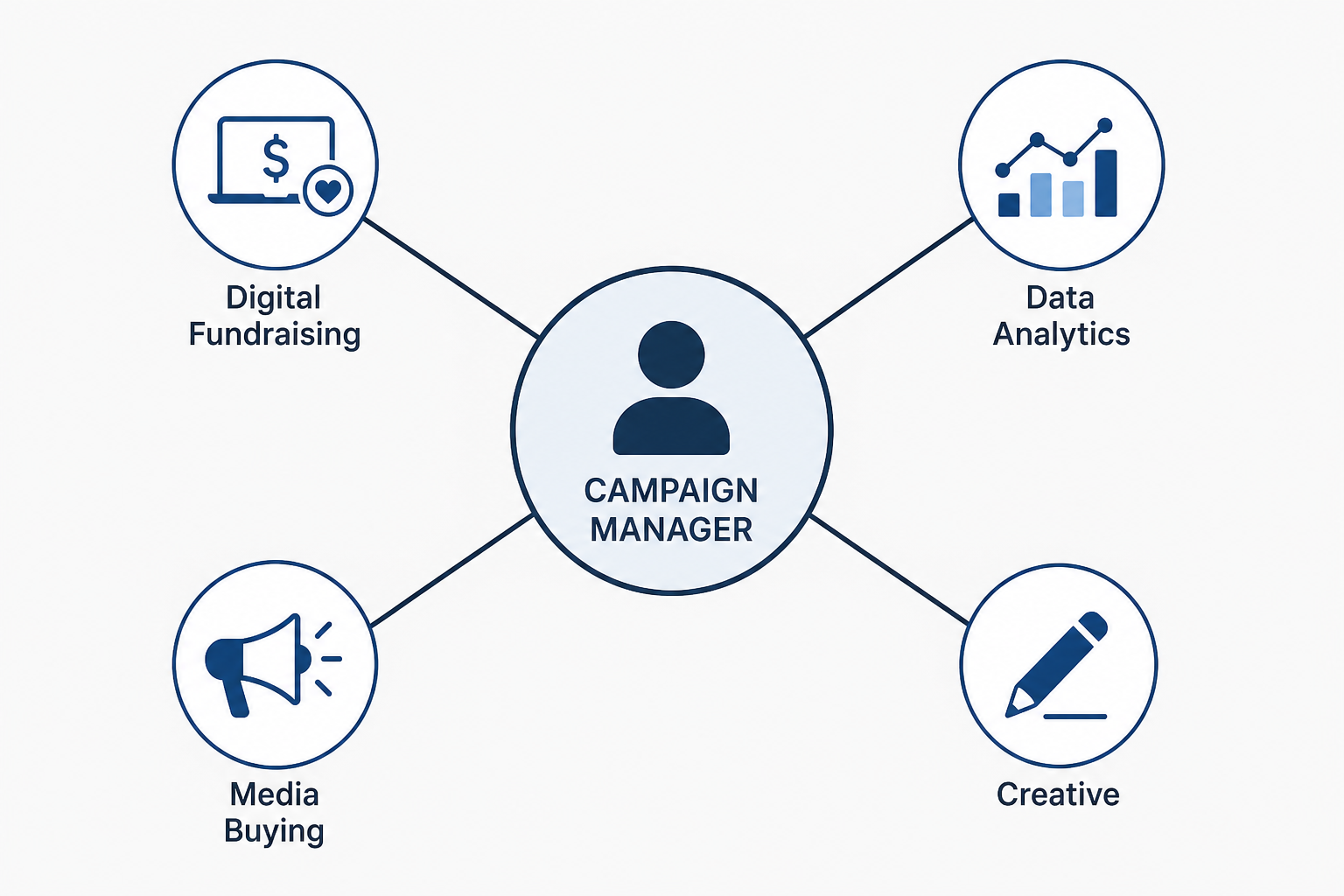
The political technology and marketing ecosystem has matured. Today, there are elite firms dedicated entirely to a single discipline, and their expertise far outstrips what a generalist firm can offer. The result is a paradigm shift away from the single-source GC and toward an agile, “a la carte” structure. In this model, the Campaign Manager steps into the role of the true general, assembling a handpicked “SWAT team” of best-in-class specialists who are leaders in their respective fields. This approach treats campaign functions not as a bundled package but as a portfolio of specialized investments, each managed by a dedicated expert.
Building Your Campaign SWAT Team: The Key Players
A modern, effective campaign structure requires a manager who can integrate the work of several key specialists. While every race is different, a winning team typically includes these core partners:
The Digital Fundraising Firm
Small-dollar fundraising is its own science, revolving around email and SMS list acquisition, A/B testing, conversion rate optimization, and donor retention. A dedicated digital fundraising agency lives and breathes these metrics. They understand the nuances of audience segmentation and messaging that can turn a one-time donor into a recurring contributor, providing the financial fuel essential for victory. This is not a task to be delegated to the junior member of a traditional consulting firm.
The Ad Buying & Media Placement Agency
The days of simply buying TV and radio spots are over. A modern media plan involves a complex mix of linear TV, Connected TV (CTV), streaming audio, social media platforms like Meta and X, and search engine marketing. A specialized ad buying firm has the expertise to navigate these disparate platforms, optimize for metrics like cost-per-impression and reach, and ensure the campaign’s budget is deployed with maximum efficiency. They focus solely on placement, leaving creative development to others.
The Data & Analytics Partner
Data is the bedrock of any modern campaign. A dedicated data firm manages the voter file, develops sophisticated models to identify persuasion and GOTV targets, and analyzes incoming data to measure program effectiveness. This intelligence informs every other department, from the ad buyer targeting swing voters on streaming services to the fundraiser identifying potential high-dollar donors. Ceding this critical function to a non-specialist is strategic malpractice.
The Creative & Content Production House
Separating creative development from media placement is a critical best practice. It allows the campaign to source the best video producers, graphic designers, and copywriters to create compelling, high-impact ads. This content can then be provided to the media buying team for placement. This unbundling prevents a common conflict of interest where a single firm might push its own in-house creative, even if it’s underperforming, because it benefits them financially.
The Strategic Advantages of the A La Carte Model
Assembling a team of specialists offers conservative campaigns distinct advantages in a competitive environment where every dollar and every vote counts.
- True Expertise: You get dedicated professionals who are at the forefront of their fields, not generalists trying to keep up with an ever-changing landscape.
- Cost-Efficiency and Transparency: By contracting directly with each specialist, campaigns avoid the hidden “GC markup,” where the general consultant takes a percentage off the top of every subcontractor’s invoice. This leads to clearer billing and often lower overall costs.
- Agility and Speed: When a strategy needs to change, the Campaign Manager can speak directly to the expert responsible. This direct line of communication allows the campaign to pivot quickly without navigating layers of bureaucracy within a large consulting firm.
- Message and Strategic Control: The Campaign Manager, who is closest to the candidate, remains the central strategic hub. This ensures all vendors are aligned with the campaign’s core message and goals, rather than having strategy dictated by an outside consultant with multiple clients.
A New Era of Campaign Management
This model is not without its challenges. It demands a highly capable and organized Campaign Manager who can effectively lead and integrate a team of independent experts, set clear goals, and facilitate constant communication. However, the benefits far outweigh the managerial burden. For conservative campaigns that need to be nimble, efficient, and data-driven to win, the era of the all-powerful General Consultant is over. The future belongs to the Campaign Manager who can build and lead a specialized SWAT team, leveraging focused expertise to achieve a singular goal: victory on Election Day.