Stop Guessing, Start Winning: A Guide to Political Ad A/B Testing
Why Your Campaign Can't Afford to Skip A/B Testing
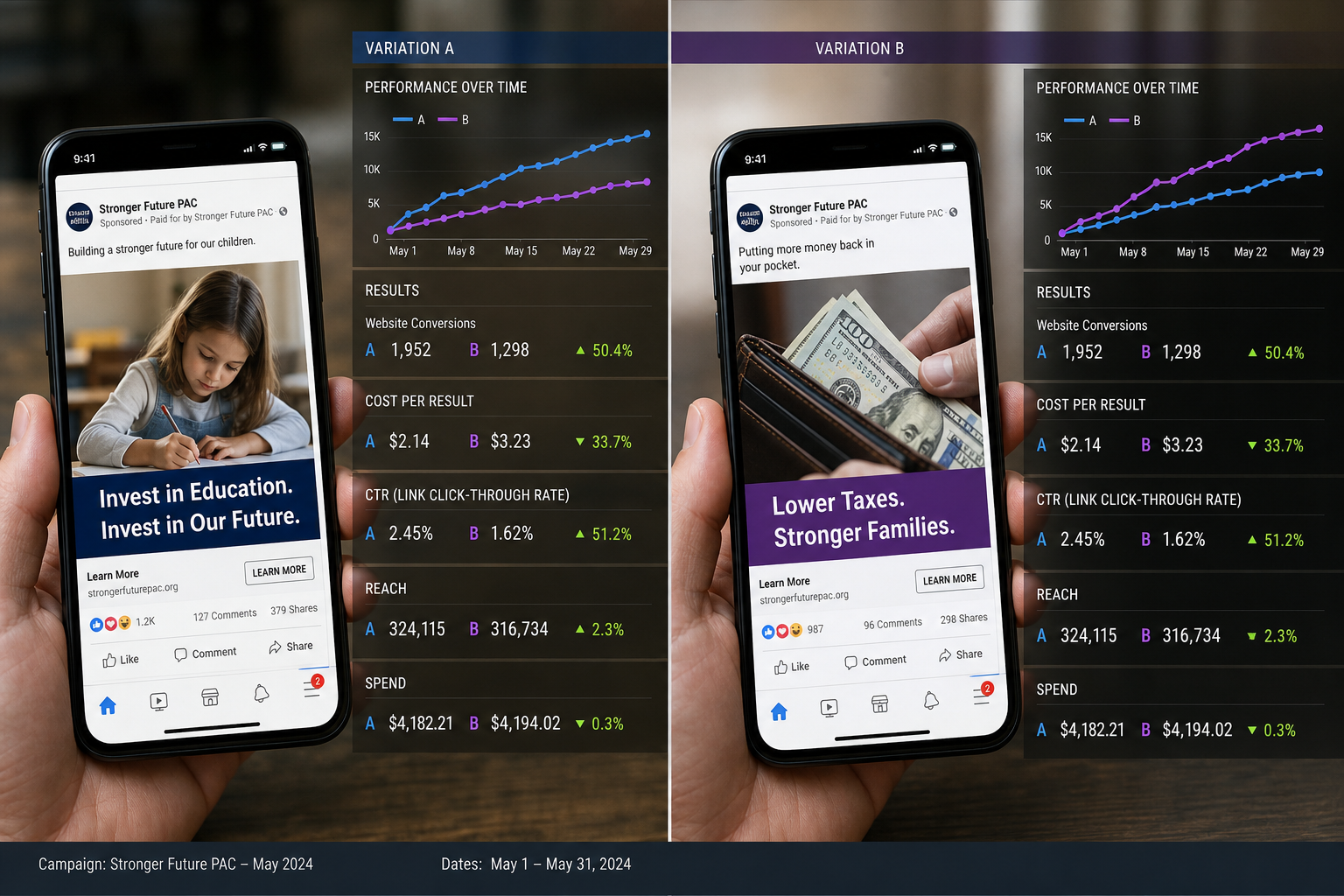
In the high-stakes arena of political campaigns, every dollar and every message matters. Yet, too many campaigns rely on intuition or past experience to guide their digital advertising strategy, effectively gambling with donor funds. A/B testing—also known as split testing—removes the guesswork. It is a disciplined, data-driven method of comparing two versions of an advertisement to determine which one performs better against a specific objective. This isn't just a best practice for corporate marketers; for political campaigns, it is an essential tool for fiscal responsibility and message discipline.
The concept is straightforward: you show Version A of an ad (e.g., with one headline) to one segment of your target audience and Version B (with a different headline) to another. By measuring metrics like click-through rates, conversion rates for signups, or cost-per-donation, the campaign can definitively identify the more effective message. In a crowded digital landscape where voters are bombarded with content, optimizing your creative and targeting isn't a luxury—it's a requirement for breaking through the noise and achieving victory.
The Conservative Imperative: Message Control and Donor Stewardship
For conservative campaigns, the strategic advantages of A/B testing are particularly potent. We often operate in a hostile media environment where our message is filtered or misrepresented. Digital advertising provides a direct channel to voters, and A/B testing ensures that the message sent through that channel is the most resonant and persuasive one possible. It allows us to listen directly to the electorate, using data—not media narratives—to understand what truly motivates them.
Furthermore, fiscal stewardship is a core conservative value. A/B testing is the digital embodiment of that principle. By continuously optimizing ads, campaigns stretch every donor dollar further, lowering the cost to acquire a new email subscriber, volunteer, or donor. This efficiency allows campaigns to expand their reach and compete more effectively, even against better-funded opponents. It transforms ad spend from a sunk cost into a strategic investment in data and voter insights.
What to Test: Key Variables for Campaign Impact
A successful testing program is systematic. Rather than randomly changing elements, focus on isolating key variables to understand their specific impact. Here are the most critical components to test in your political ads:
1. Ad Creative and Copy
- Imagery and Video: Test a polished photo of the candidate against a more candid, behind-the-scenes shot. Compare a graphic with a bold policy statistic to an image of a family. For video, test different thumbnails or even the first three seconds of content, as that is where viewer attention is won or lost.
- Headlines: The headline is the first thing a voter reads. Test a question-based headline ("Are You Concerned About Border Security?") against a declarative statement ("A Plan to Secure Our Border.").
- Primary Text: Compare a long-form, policy-deep dive with a short, punchy, value-oriented message. Does your audience respond better to detailed substance or an emotional appeal?
2. Call to Action (CTA)
The CTA tells voters what you want them to do next. The right CTA depends on the campaign's objective for that specific ad. Test direct, high-commitment asks against softer, engagement-focused ones:
- Fundraising: "Donate Now" vs. "Contribute Today" vs. "Chip In $5"
- List Building: "Sign Up" vs. "Join the Movement" vs. "Get Updates"
- Persuasion: "Learn More" vs. "Watch Now" vs. "Read Our Plan"
3. Audience Targeting
Even the best ad creative will fail if it’s shown to the wrong people. Digital platforms like Meta (Facebook) and Google offer powerful targeting tools, and testing is crucial to unlock their full potential.
- Interest and Behavioral Targeting: Test distinct audience segments. For example, run the same ad to an audience interested in "small business" and another interested in "Second Amendment rights" to see which group is more responsive.
- Lookalike Audiences: Compare the performance of a 1% lookalike audience of your donor list (highly similar) versus a 3-5% lookalike (broader reach). This helps you find the right balance between precision and scale.
- Geographic Targeting: For local races, test messaging variations between different zip codes or neighborhoods to identify hyper-local concerns.
A Framework for Disciplined Testing
To implement A/B testing effectively, follow a structured process:
- Formulate a Clear Hypothesis: Start with an educated guess. For example: "We hypothesize that using an image of the candidate with their family will result in a lower cost-per-click than a standard headshot among suburban female voters."
- Isolate a Single Variable: This is the golden rule of A/B testing. If you test a new headline and a new image in the same ad, you won't know which change was responsible for the difference in performance. Change only one element at a time.
- Run the Test to Statistical Significance: Don't end the test after a few hours or a handful of clicks. Allow the ad platform, such as Meta's A/B Test tool, to gather enough data to declare a winner with high confidence. This prevents you from making decisions based on random fluctuations.
- Analyze Results and Iterate: Once a winner is declared, pause the losing ad. The winning ad now becomes your new control. Formulate a new hypothesis and test another variable against it. This creates a cycle of continuous, incremental improvement.
From Data to Decisive Action
In a political environment defined by noise and uncertainty, data-driven decision-making provides a critical edge. A/B testing moves your campaign’s digital advertising from an art to a science, ensuring your message is not only heard but acted upon. By embracing this discipline, conservative campaigns can amplify their strengths, practice responsible stewardship of resources, and build a more precise, powerful connection with the voters they seek to serve. It's time to stop guessing and start winning the digital battle for hearts and minds.