The AI Sparring Partner: Revolutionizing Debate Prep for Modern Campaigns
Beyond the Binder: A New Era for Campaign Debate Prep
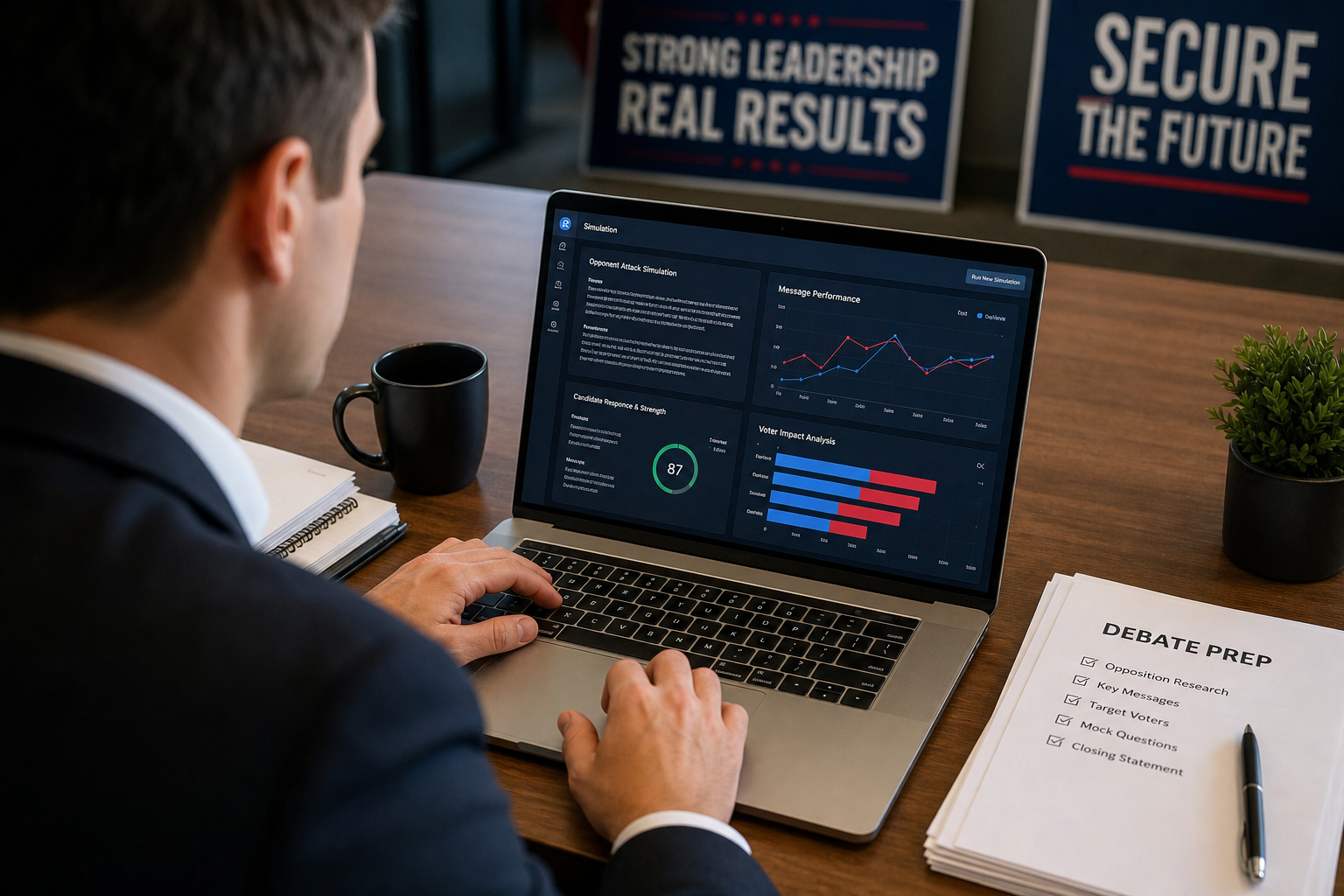
For decades, political debate preparation has followed a predictable script: dense policy binders, marathon mock sessions, and staff members playing the role of the opponent. While time-tested, this approach is labor-intensive and limited by the imaginative capacity of the human team. Today, the emergence of sophisticated large language models (LLMs) offers a transformative alternative. Campaigns are now leveraging artificial intelligence to create dynamic, data-driven debate simulations that sharpen messaging, anticipate attacks, and prepare candidates with a level of rigor previously unattainable.
For conservative campaigns seeking to deliver a clear, principled message in a hostile media environment, AI-driven preparation is not a novelty—it is a strategic necessity. This technology provides a powerful tool to pressure-test arguments, develop resilient responses, and ensure the candidate is prepared for any line of questioning, no matter how unexpected.
How AI Simulates Opponents with Unprecedented Accuracy
The core of AI-assisted debate prep lies in its ability to create a highly realistic digital sparring partner. By training an LLM on an opponent’s entire public record—including speeches, voting history, social media posts, op-eds, and past debate transcripts—campaigns can generate responses that mimic the opponent's rhetorical style, logical fallacies, and go-to pivot points.
Key advantages of this approach include:
- Anticipating Attack Vectors: An AI model can analyze vast datasets to identify patterns and surface potential attack lines that a human team might miss. It can connect a candidate’s past vote to an obscure statement made years ago, simulating the kind of “gotcha” moments that define modern debates.
- Realistic Rhetorical Style: Beyond just the substance, the AI can be prompted to respond in character. Does the opponent favor emotional appeals, Gish gallops of statistics, or ad hominem attacks? The simulation can replicate these specific tactics, allowing the candidate to practice maintaining composure and message discipline against a lifelike adversary.
- Scalable Scenario Testing: A human sparring partner gets tired. An AI does not. Campaigns can run hundreds of simulations, testing a candidate's response to the same question framed in subtly different ways, until the messaging is concise, compelling, and second nature.
Refining Messaging with AI-Powered Voter Personas
Effective debate performance isn't just about defense; it's about connecting with the audience. AI can also be used to test how specific messages land with key voter demographics. By creating detailed AI “voter personas” based on campaign data—such as a “suburban mother in a swing district concerned about inflation” or a “Gen Z fiscal conservative worried about national debt”—strategists can A/B test messaging in a controlled environment.
The process is straightforward: the candidate delivers a policy explanation or soundbite, and the AI, acting as the designated persona, provides feedback. It can articulate which arguments are persuasive, which phrases are confusing or alienating, and what follow-up questions that type of voter might ask. This rapid feedback loop allows campaigns to refine their talking points to resonate more effectively with the specific segments they need to win over, ensuring that complex conservative ideas are communicated with clarity and impact.
Best Practices for Implementing AI in Debate Prep
Integrating AI into your strategy requires more than just access to the technology. To be effective, campaigns must follow a structured approach:
- Data Quality is Paramount: The maxim “garbage in, garbage out” is especially true here. The simulation’s effectiveness depends entirely on the quality and comprehensiveness of the data used to train it. A dedicated effort to compile a clean, extensive dataset of the opponent’s record is the critical first step.
- Keep a Human in the Loop: AI is a tool to augment human strategy, not replace it. The AI generates possibilities and identifies patterns, but it is the campaign manager and communications director who provide the strategic judgment, emotional nuance, and final word. Use the AI’s output as a starting point for strategic discussions.
- Focus on Agility, Not Scripts: The goal of AI simulation is not to memorize robotic answers. It is to build a candidate’s mental agility and confidence. By exposing them to a wide range of scenarios and attack styles, they learn to think on their feet and consistently pivot back to their core message.
- Maintain Message Discipline: Use the simulations to rigorously train the candidate on bridging from any question back to the campaign’s central themes. The AI can be programmed to relentlessly pull the candidate off-message, providing essential practice for staying focused under pressure.
The Conservative Advantage in a New Media Landscape
In an era where conservative principles are often misrepresented by legacy media, the ability to communicate with precision is a non-negotiable. AI-driven debate prep gives conservative candidates a distinct advantage by allowing them to pre-bunk likely media narratives and opponent spin. It provides a private forum to practice defending constitutional values, free-market policies, and traditional principles against the most challenging progressive critiques, ensuring candidates are never caught flat-footed.
As campaigns continue to seek every possible edge, those that embrace data-driven tools for preparation will be better equipped to control the narrative, build trust with voters, and perform with confidence when the spotlight is on. AI is no longer science fiction; it is the new frontier of winning political communication.