The Attention War: How Campaigns Compete for Seconds, Not Votes
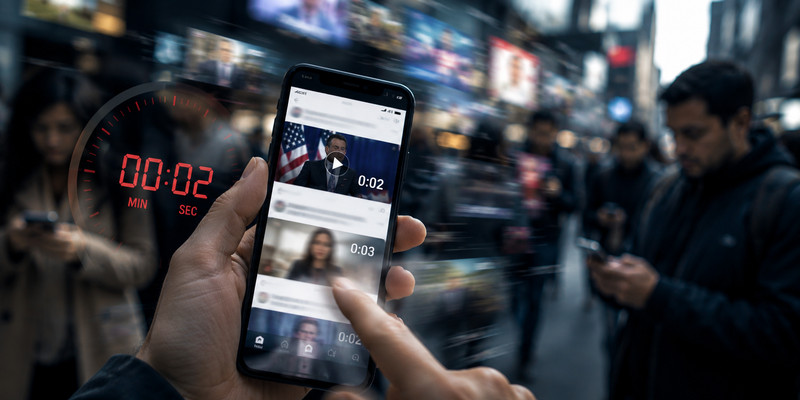
The modern political campaign doesn't begin with persuasion. It begins with visibility.
Before a message can influence a voter, it has to reach them — and in today's digital environment, that is no small task. Voters are constantly moving between platforms, consuming content in short bursts, and filtering information at a pace campaigns are still trying to catch up to. The result is a new kind of competition, one defined not by ideas alone, but by the ability to capture attention in an instant.
The Shrinking Window
Attention has become compressed. What once allowed for explanation now demands immediacy. Campaigns are no longer operating in minutes or even seconds — they are operating in moments.
UC Irvine Chancellor's Professor of Informatics Gloria Mark, who has studied how people focus on screens for more than two decades, found that the average attention span has dropped from two and a half minutes in 2004 to just 47 seconds today — a two-thirds collapse that leaves campaigns a vanishingly small window to register before a voter's attention has already moved on. A voter scrolling through a feed makes the stop-or-skip decision almost instantly. If the content doesn't hold them in that moment, the quality of the message underneath it becomes irrelevant. Mace Magazine
This has forced a shift in priorities. Campaigns are no longer just refining what they say. They are restructuring how they present it.
Content Designed for Speed
In this environment, content must function differently. It has to communicate value immediately, without relying on long explanations or layered messaging.
That doesn't mean substance disappears. It means substance is delivered in stages.
The first interaction captures attention. The second builds recognition. The third begins to inform. Four pre-registered experiments published in PLOS ONE found that voters consistently preferred candidates whose names appeared more frequently in their media environment — even when they had no additional information about either candidate — which means the repeated presence that makes deeper engagement possible has to be earned through the quick interactions that happen long before a voter is ready to pay close attention. Campaigns that understand this progression guide voters from quick engagement to deeper alignment over time. Those that don't are left trying to explain complex ideas to audiences that have already moved on. The American Prospect
Platform Behavior Shapes Outcomes
Every platform operates on its own set of rules. What captures attention on one may fail completely on another. Campaigns can no longer rely on a single message distributed broadly — they must adapt to how users behave within each digital space.
This requires more than creativity. It requires data.
Facebook's own platform research revealed that the average attention span for video content is just two seconds — 2.5 seconds on desktop and 1.7 seconds on mobile — a constraint that makes the difference between content built for instant impact and content built for traditional reading formats a decisive competitive gap. Campaigns now track how long users engage, when they drop off, and what triggers interaction. These signals provide a clearer picture of how attention actually works, allowing campaigns to refine their approach with precision rather than guesswork. Over time, this creates a measurable advantage. Campaigninnovation
The Cost of Invisibility
In a saturated digital environment, being ignored is more damaging than being opposed.
Industry research published between 2023 and 2025 estimates that the average person is now exposed to between 6,000 and 10,000 advertising messages per day, driven largely by mobile apps, social media feeds, in-app promotions, and push notifications — a volume so dense that any campaign failing to maintain consistent presence isn't just less visible, it effectively doesn't exist in that voter's information environment. Other voices fill the gap — media narratives, opposition messaging, organic online discussion — and once those narratives take hold, they become significantly harder to displace.
Visibility, in this sense, is not just about exposure. It is about maintaining relevance.
Sustaining Attention Over Time
Capturing attention once is not enough. Campaigns must find ways to remain present without overwhelming their audience.
This requires a balance between consistency and variation. Messaging must stay aligned, but the format and delivery must evolve to keep engagement from fading. Campaigns that achieve this create familiarity without fatigue — an outcome that strengthens recognition and builds trust over time.
This is where long-term strategy begins to matter. Attention is not a one-time win. It is something that must be maintained.
The Shift Campaigns Can't Ignore
The competition for attention will only intensify. Content volumes will increase, platforms will continue to evolve, and voter behavior will become even more fragmented.
Campaigns that succeed will not be the ones that simply produce more content. They will be the ones that understand how attention works — when it happens, where it happens, and why it's given in the first place.
Because in today's environment, influence doesn't begin with persuasion. It begins with being seen.