The Rise of Automated A/B Testing: How Campaigns Are Optimizing Faster Than Ever
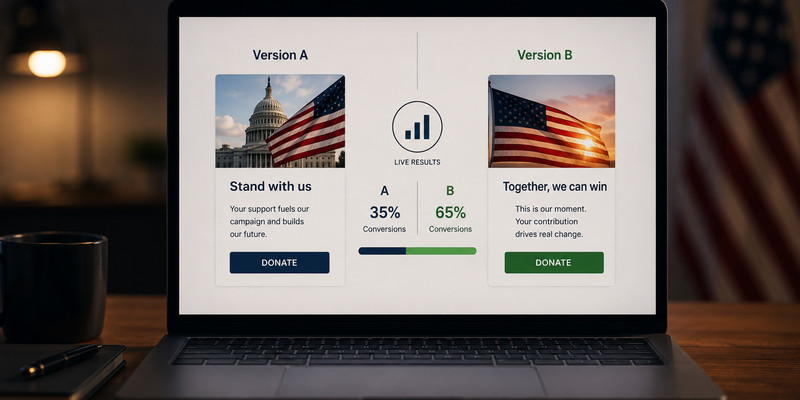
Political campaigns have always run on iteration. A consultant tests a mailer in one precinct before rolling it out statewide. A digital director tweaks ad copy after a week of underwhelming click rates. A finance director changes the subject line on a fundraising email and watches the open rate shift. This kind of trial-and-error has been part of campaign strategy for decades.
What has changed is the speed, scale, and intelligence behind the process. Automated A/B testing — powered by AI and machine learning — has compressed what used to take weeks into hours, replaced human guesswork with statistically validated decisions, and transformed experimentation from an occasional tactic into a continuous strategic engine. For campaigns willing to build it into their operation, the competitive implications are significant.
The Old Way Had a Hidden Price Tag
Before automated testing platforms became accessible, running a proper A/B test on a piece of campaign communication required meaningful time investment. A digital team would build two versions of an email, let them run for several days to accumulate enough data, manually analyze the results, implement the winner, and move on. For a single message in a single channel, that cycle might take a week or more.
The cost wasn't just time. It was opportunity. A campaign sending fundraising emails to a list of 200,000 donors across a six-week push had only a handful of testing cycles available if each test ran for seven to ten days. Most variations never got tested. Most assumptions never got challenged. The "winning" version of a message was often the one a strategist liked most — not the one donors actually responded to.
Automated testing changes the math entirely. Modern platforms use machine learning to allocate traffic dynamically — serving more impressions to better-performing variants in real time as data accumulates — rather than waiting for a test to conclude before shifting resources. What used to take ten days can produce statistically reliable results in hours, depending on traffic volume.
Proof That Testing Pays
The case for structured testing isn't theoretical. VWO's benchmarking data shows that campaigns running structured A/B tests with proper sample sizes and statistical rigor regularly achieve conversion lifts of 10% to 28% on winning variants — and those gains compound across every element of a campaign's digital presence. The same research found that roughly 77% of firms globally now conduct A/B tests on their websites, reflecting how mainstream the discipline has become in the commercial world.
Political campaigns are catching up, but the adoption gap remains real. The commercial world treats experimentation as standard operating procedure. Most campaigns still treat it as an occasional diagnostic. Closing that gap — even partially — represents a meaningful performance advantage for campaigns that move first.
Four Places Campaigns Are Winning With It Now
The highest-value applications of automated A/B testing in political campaigns cluster in four areas.
Fundraising email optimization is where the ROI case is clearest. Subject lines, send times, opening sentences, donation ask amounts, and urgency framing are all testable variables — and small lifts in open or conversion rate, applied across a large list, translate directly into dollars raised. Tech for Campaigns reported that their AI-assisted drafting and testing system reduced average drafting time by 34% while maintaining high performance metrics including open rate, click rate, and donation rate — meaning campaigns get faster iteration without sacrificing quality.
Digital ad creative testing uses automated platforms to run multiple ad variants simultaneously — different images, headlines, calls to action — and automatically shift budget toward top performers as data accumulates. Rather than committing spend to a creative direction before knowing how it performs, campaigns can let real audience behavior decide within the first hours of a flight.
Landing page and donation form optimization tests layout, copy, button placement, and ask string structure to identify which configurations convert best. These are often low-visibility changes with outsized impact — a small improvement in donation page conversion rate affects every dollar of traffic a campaign sends to that page for the rest of the cycle.
Voter contact message testing — across SMS, digital canvassing scripts, and paid social — allows campaigns to validate which issue framings and messenger voices generate the strongest response before committing to a full program rollout.
Learning Faster Is a Structural Advantage
The deeper value of automated testing isn't just better creative — it's faster learning. A campaign that can run five validated tests per week learns about its voters and donors at a fundamentally different rate than one running five per month. That accumulated knowledge — which messages land, which asks convert, which channels drive action — compounds across the cycle and becomes a structural advantage that's difficult for a slower-moving opponent to close.
Research from McKinsey on personalization and experimentation programs found that companies executing structured testing effectively see 10% to 30% improvement in marketing ROI — a range that translates directly into campaign context as better-performing fundraising, lower cost-per-voter-contact, and more efficient persuasion spend.
The campaigns building this capability aren't necessarily the largest or best-funded. They are the ones treating experimentation as infrastructure — not a project, not a quarterly initiative, but a standing operational discipline that runs continuously alongside everything else the campaign is doing.
Stop Leaving Performance on the Table
If your campaign is currently testing one or two things per cycle and calling that an optimization program, you're leaving the majority of your performance gains untouched. The tools to do more are accessible at every budget level. The methodology is well established. The data — from your own donor list, your own ad traffic, your own voter contact universe — is already there.
The question isn't whether your campaign should be running automated A/B tests. At this point, in a competitive environment where every point of conversion rate and every dollar of cost efficiency matters, the real question is why you'd wait any longer to start.