The Rise of Digital Neighborhoods
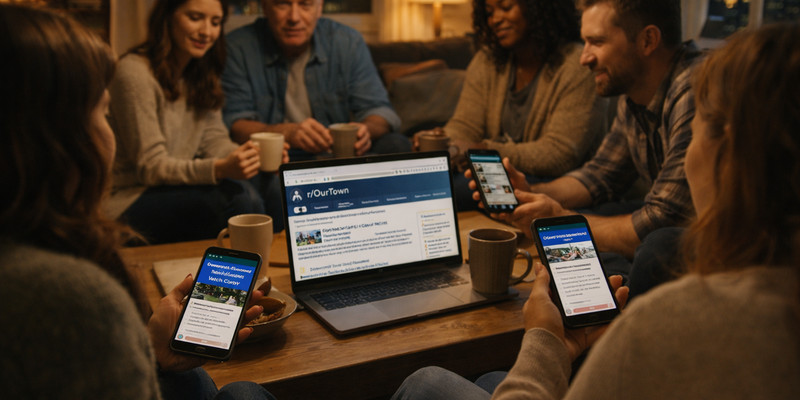
The country didn’t stop talking politics — it just stopped doing it in the same places. The old model assumed a few big stages: cable news, major papers, Facebook feeds, maybe a splashy rally or two. But public attention has splintered into thousands of smaller rooms, and campaigns that keep shouting at the main stage are missing where people actually live now. The new persuasion map looks less like a broadcast tower and more like a patchwork of digital neighborhoods.
From Mass Audience to Many Tribes
A digital neighborhood is any online space where people gather around shared identity, interest, or locality and start to feel like a community instead of a crowd. Sometimes that’s literal geography — a city Facebook group, a state-based subreddit, a neighborhood Discord, a group chat for parents at the same school. Sometimes it’s cultural or practical — a Substack community built around faith and family, a forum for veterans, a hunting group, a homeschool network, a small-business circle, a gaming server, a fitness community, a local newsroom comment section that hasn’t died yet.
The key point: these spaces don’t behave like public feeds. They don’t reward you for being loud. They reward you for being known.
Digital Neighborhoods Are Trust Networks
Public platforms are where people perform opinions. Neighborhood spaces are where they test them. People ask questions they wouldn’t ask on a timeline. They admit doubts. They compare notes. They look for guidance from someone who seems credible in the room. It’s the same dynamic as real life: you might watch the news, but you decide what you believe over dinner with people you trust.
For campaigns, that means persuasion is less about “reaching a demographic” and more about earning a place inside social trust networks.
Why These Spaces Matter More Than Ever
Three forces built the digital neighborhood era.
First, institutional trust collapsed. When big media and big platforms are seen as rigged, people retreat to smaller circles where trust is personal.
Second, algorithms turned public feeds into chaos. Everyone knows the timeline is manipulated by trend-chasing incentives. People want calmer spaces.
Third, online life matured. The internet is no longer a novelty — it’s a social infrastructure. Adults don’t just browse it. They belong to it.
Campaigns that ignore these forces are campaigning in a world that no longer exists.
Stop Treating Communities Like Ad Inventory
The fastest way to get rejected in a digital neighborhood is to enter like a marketer. If a campaign shows up dropping canned talking points or obvious ads, people smell it instantly. The group’s immune system kicks in. The post gets mocked, removed, or quietly ignored. You don’t just lose that space — you lose reputation in adjacent spaces because these communities overlap.
A digital neighborhood is not a billboard. It’s a kitchen table. You don’t walk into someone’s kitchen and start reading press releases.
Lead With Listening
The right entry move is boring and powerful: listen first. Learn the culture of the room before you try to speak in it.
What are people anxious about?
What language do they use?
Who do they trust?
What stories are repeated?
What jokes land?
What line do they not cross?
Campaigns used to do this through field organizing. Digital neighborhoods require the same humility. You don’t earn permission by being clever. You earn it by respecting the room.
Recruit Local Anchors
Every neighborhood has anchors — people who hold social gravity. Sometimes it’s a formal admin. Sometimes it’s a commenter who always seems informed. Sometimes it’s a creator who is “one of us” to the group. Sometimes it’s a church leader who runs a private channel. The campaign’s job is not to replace these anchors. It’s to partner with them.
This is where digital meets old-school politics nicely: the most persuasive message is delivered by someone with relational credibility. A campaign can’t manufacture that from scratch. But it can honor it, support it, and give it useful tools.
Provide Value Before You Ask for Anything
Campaigns tend to show up in communities when they want something: a donation, a volunteer, a share. That’s backwards in neighborhood logic. Neighborhoods reward contributors, not extractors.
Provide value first:
clear answers to practical questions,
resources that solve a local problem,
concise explanations of policy stakes,
event info people actually need,
ways to help their community even beyond voting.
When your presence improves the room, you become welcome. When your presence feels like a sales pitch, you become a nuisance.
Message Discipline Still Matters
One risk of neighborhood politics is fragmentation. If you tailor your voice too much to each room, you start sounding like you don’t know who you are. People can accept cultural translation; they don’t accept moral shapeshifting.
The fix is message discipline with flexible delivery. The core story stays steady. The examples shift. The tone adapts for human respect, not pandering. Real communities prefer a consistent neighbor over a slick chameleon.
Make It Easy to Participate
Digital neighborhoods aren’t passive audiences. They’re action-ready environments if you lower friction. When someone is already part of a trusted group, they’re more likely to show up for a cause that feels aligned with community life.
So campaigns should build participation ladders that fit neighborhood habits:
low-pressure shareable content for private threads,
small local meetups anchored by trusted members,
volunteer tasks that feel like community service instead of campaign drudgery,
simple opt-ins that don’t require a privacy leap of faith.
Participation should feel like an extension of belonging, not a transaction.
The Quiet Advantage of Decentralization
Big platforms can throttle reach. Digital neighborhoods are harder to throttle because they are decentralized. A message shared inside a hundred small rooms is more resilient than a message dependent on one algorithm.
This decentralization also protects credibility. When your story spreads through trusted circles, it carries a different authority than when it shows up as a forced ad on a public feed. People don’t just hear it — they inherit it through social proof.
Measure Differently
Traditional digital metrics will understate neighborhood gains. You may not see a neat attribution trail. That doesn’t mean nothing is happening. Neighborhood persuasion shows up as:
sustained local momentum,
repeat engagement by the same community,
rising volunteerism,
organic defense of your message by members,
steady growth in opt-in channels.
If a group starts carrying your story without you, you’re winning.
The Future Is Relationship at Scale
Digital neighborhoods don’t mean going backward to small politics. They mean scaling relationship politics. The campaign that wins next isn’t the one with the loudest megaphone. It’s the one with the widest trust footprint — a network of communities that know your voice, understand your priorities, and feel respected when you enter their space.
In the end, politics hasn’t changed as much as the map has. People still decide based on who they trust. The only difference is that those trust circles now live online as much as they do on the block. Campaigns that treat these neighborhoods like places — with humility, value, and steady character — won’t just reach voters. They’ll belong where voters already are.