The Small Donor Surge: How Micro-Donation Strategies Are Reshaping Campaign Finance
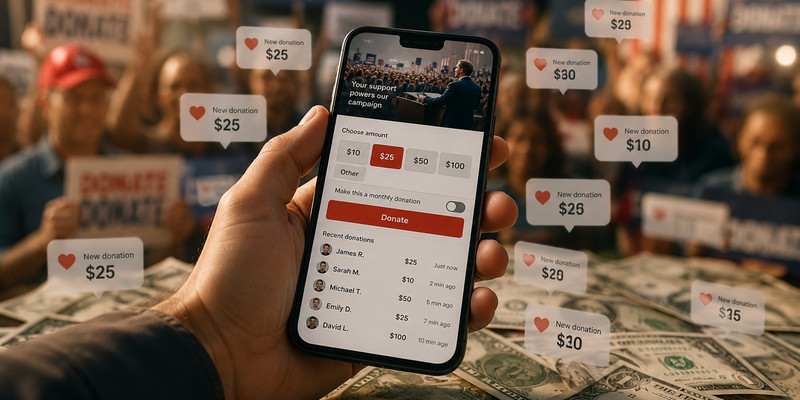
For most of political history, campaign fundraising was a relationship business conducted at the top of the wealth pyramid. The major donor call time, the high-dollar event, the six-figure PAC check — these were the mechanisms through which campaigns capitalized themselves, and they required access to networks most candidates spent years building. Grassroots fundraising existed, but it occupied a supporting role.
That architecture has shifted dramatically. The rise of digital fundraising platforms, real-time mobile payment infrastructure, and a donor base that is genuinely motivated to give in small amounts on a repeated basis has produced a small donor ecosystem powerful enough to fund serious campaigns at every level — and in the process, it has changed what financial strength actually looks like in a competitive race.
The Numbers Behind the Shift
The scale of what has happened in small-dollar political fundraising over the past decade is not incremental — it's structural. WinRed's 2024 cycle recap reported that 4.5 million donors gave $1.8 billion to Republican candidates and organizations through the platform — a 68% increase in the number of donors compared to the previous cycle. Over 5,800 campaigns and organizations used the platform in 2024, a 177% increase in usage in just four years. That growth trajectory reflects something deeper than a single election cycle bump: it reflects a permanently expanded base of small-dollar conservative donors who have been activated, retained, and grown through deliberate platform investment.
The cumulative picture is even more striking. According to the Federal Election Commission, WinRed processed $5.6 billion in contributions from 8.8 million donors across three election cycles since 2019. That is a donor base built almost entirely from small contributions — and it represents a structural advantage that compounds as retained donors give again and again across multiple cycles.
Why Small Donors Are More Valuable Than Their Individual Gifts Suggest
The instinct to measure small donors by the size of a single contribution misses the more important variable: what they're worth over time. A donor who gives $25 once is a transaction. A donor who gives $25 every month for four years is a relationship worth $1,200 — and the data on recurring donor retention makes the math even more favorable.
Neon One's 2026 Recurring Donor Report found that recurring donor retention rates held steady between 78% and 80%, compared to just 32.41% for non-recurring donors over the same period. The average recurring donor stays engaged for 7.77 years — more than four times the 1.7-year lifetime of a non-recurring supporter. For campaigns building multi-cycle organizations rather than single-race operations, those retention figures change the fundamental economics of grassroots fundraising.
The implications for campaign finance strategy are direct. A recurring donor base doesn't just provide revenue — it provides predictable revenue, which changes how campaigns plan. A finance director who knows that $50,000 in recurring monthly commitments is hitting every first of the month can build a budget around that floor rather than chasing one-time gifts to cover operational costs in slow fundraising periods.
The Platform Infrastructure Now Exists at Every Level
One of the most significant developments of the past several cycles is that sophisticated small-donor fundraising infrastructure is no longer exclusive to presidential or major Senate campaigns. The tools, platforms, and donor network effects that once required institutional scale to access are now available to congressional candidates, statewide races, and competitive down-ballot campaigns.
WinRed's expansion in 2020 to support all Republican candidates — from school board to Senate — democratized access to the conservative donor network in a way that fundamentally changed the competitive landscape for lower-ballot races. A first-time candidate for state legislature running in a competitive district can now tap into a platform with millions of saved donor profiles, recurring gift infrastructure, and cross-campaign conduiting tools that were simply not available to that class of candidate five years ago.
The competitive implication is significant: a down-ballot campaign that builds a small-donor base early in its cycle enters the final weeks with resources and momentum that no single last-minute major donor check can replicate on short notice.
Building a Micro-Donation Program That Actually Works
The campaigns converting small-donor potential into fundraising reality share a set of operational practices that distinguish them from campaigns treating digital fundraising as a supplementary afterthought.
Recurring gift conversion is the highest-leverage intervention in any small-donor program. Converting a one-time donor to a monthly recurring commitment changes their expected lifetime value by a factor of four or more. The ask needs to happen explicitly — at the point of first donation, in follow-up emails, and at key campaign moments — with clear messaging about what the sustained commitment enables.
Urgency architecture in fundraising emails and donation pages — deadlines, matching periods, goal thermometers — consistently lifts both conversion rates and average gift sizes by creating a concrete reason to give now rather than later. These aren't manipulation tactics; they're the same deadline mechanics that drive action in any sales or fundraising environment.
Donor segmentation by giving behavior — separating new donors from lapsed donors from active recurring donors — allows campaigns to send different messages with different asks calibrated to where each donor is in their relationship with the campaign. A first-time donor getting the same email as a five-year recurring supporter is a missed opportunity on both ends.
The Loyalty Dimension
There is a dimension to small-donor fundraising that the pure revenue math understates: the relationship it creates between donors and candidates. A voter who has given $25 a month for six months to a campaign has made a personal investment that changes how they experience the race. They follow it more closely. They talk about it more. They're more likely to volunteer, share content, and bring others into the fold.
McKinsey's research on word-of-mouth and purchase decisions has long documented that customers who make repeated small financial commitments to a brand become its most vocal advocates — a dynamic that translates directly to political donors. The small-donor base is not just a revenue source. It is the campaign's most motivated constituency, and building it deliberately is one of the highest-return strategic investments a campaign can make.