The Tools Gap Is Closing for Down-Ballot Campaigns
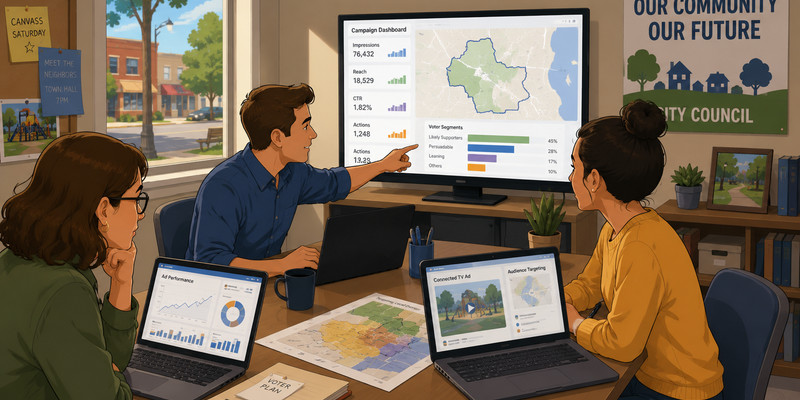
For most of political advertising history, the gap between a Senate campaign and a city council race was not just a difference in budget — it was a difference in capability. Top-of-ticket campaigns had access to data infrastructure, programmatic buying, precision targeting, and professional media production that down-ballot candidates simply could not afford. The playing field was never level, and most campaigns accepted that as a structural reality.
That reality is changing faster than most campaigns realize.
What Used to Cost a Fortune
The tools that defined big-budget political campaigns for the past decade — programmatic advertising, connected TV, AI-driven targeting, behavioral voter data — were built for high-spend environments. Minimum buys were high, setup costs were significant, and the technical infrastructure required to run sophisticated digital campaigns was out of reach for races operating on five-figure budgets.
The result was a compounding disadvantage. Down-ballot candidates not only had less money — they were getting less per dollar because they lacked access to the targeting efficiency and audience precision that made larger campaigns' spending so effective. A state legislative candidate running display ads without proper audience segmentation was paying to reach voters who would never be in their district.
The Infrastructure Shift
The combination of programmatic maturation, AI-driven optimization, and platform competition has systematically lowered the cost of entry across every major digital channel.
Basis Technologies analyzed more than 1,400 campaigns across state, local, and national races and found that CTV increased its programmatic ad share of impressions from 11% in 2022 to 24% in 2024, and its share of digital spend from 30% to 50% over the same period — a shift driven in large part by the proliferation of buying paths that made CTV accessible beyond the largest campaigns. What was once a channel reserved for statewide races is now being deployed at the district level because the infrastructure to buy it efficiently finally exists at lower spend thresholds.
AI has accelerated this further. Harvard's Ash Center for Democratic Governance notes that AI's unique value in campaign operations is the speed, scale, and scope it enables — capabilities that allow campaigns to scale communication efforts and voter outreach in ways that were previously impossible without significantly larger teams and budgets. For a down-ballot campaign that previously had to choose between voter contact and digital advertising because it couldn't afford both, AI-driven automation is collapsing that tradeoff.
What It Looks Like on the Ground in 2026
The practical implications for down-ballot campaigns in the current cycle are concrete.
Adwave's 2026 political advertising trend analysis, citing MadHive data, found that a school board candidate spending $2,000 on programmatic CTV can now reach over 80,000 targeted impressions within their specific district — often outperforming a single broadcast buy at the same budget — and that the barrier to entry for TV-style advertising has dropped from tens of thousands of dollars to as little as $50 through programmatic platforms. Candidates who never had access to television are running ads on the same streaming platforms as Senate campaigns. The targeting objection that ruled out TV for small races no longer applies when household-level district targeting is available at any spend level.
This is why down-ballot advertising is now one of the fastest-growing segments in political media. The tools gap that defined the last decade of campaign technology is closing — not gradually, but at a pace that is making the 2026 cycle fundamentally different from 2022.
The Strategic Implication
Access to better tools does not automatically produce better results. The down-ballot campaigns that will benefit most from this shift are the ones that treat the new infrastructure as a strategic opportunity rather than a feature to check off a media plan.
A few things matter most:
- Precision over volume — the advantage of programmatic for small campaigns is not reach, it is efficiency. A targeted $5,000 CTV buy that reaches only in-district households outperforms a $15,000 broadcast buy that wastes two-thirds of its impressions
- Data hygiene before spending — the same voter data quality problems that affect large campaigns affect small ones, and AI-driven targeting is only as good as the list it is working from
- Sequencing the message — down-ballot candidates have lower name recognition, which means the introduction has to come before the argument. Spending on persuasion before awareness is established wastes both
The Competitive Reality
The closing of the tools gap cuts both ways. It means down-ballot campaigns now have access to capabilities that were previously out of reach — but it also means their opponents do too. The campaigns that move fastest to deploy these tools effectively will gain an advantage that compounds over the cycle. Those that wait for proof of concept will find themselves reacting to opponents who have already built audience relationships and optimized their messaging.
The tools are available. The question heading into 2026 is which campaigns are actually using them.