Why Campaigns That Ignore Dark Social Are Missing Their Most Loyal Supporters
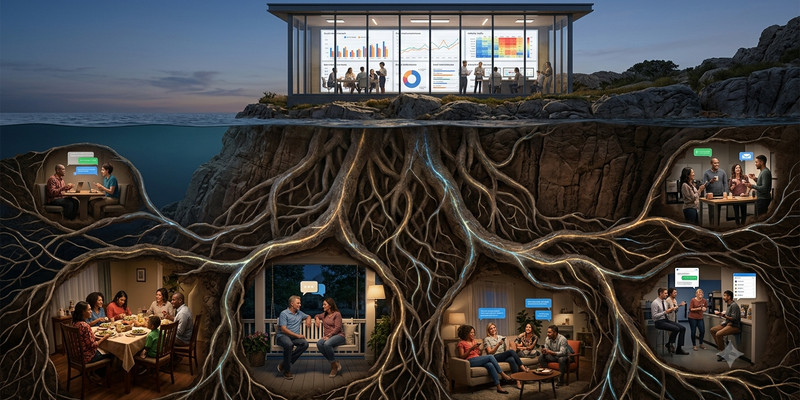
Every campaign tracks the same metrics. Click-through rates on digital ads. Email open rates. Social media reach and engagement. Website traffic by channel. These numbers feel concrete, and they are — but they represent only the share of political communication that happens in the open. Underneath them runs a much larger current: the private conversations where voters actually make up their minds.
A text from a neighbor saying "I just watched this candidate's speech, you should see it." A link dropped into a family group chat. An email forwarded between colleagues with a quick note attached. These interactions don't show up in a campaign's analytics dashboard. They register, if at all, as "direct traffic" — a catch-all category that tells a campaign almost nothing about where a visitor actually came from. This is dark social: the sharing that happens in channels that analytics tools can't trace, and it is almost certainly where the most persuasive political communication in any cycle is occurring right now.
The Scale of What Campaigns Aren't Seeing
The data on dark social's footprint is striking enough to reframe how campaigns think about attribution entirely. SparkToro's research on dark social traffic attribution found that platforms including TikTok, Slack, Discord, and WhatsApp fail to pass referral data to analytics tools nearly 100% of the time — meaning clicks driven by content shared through those channels arrive at a campaign's website with no trace of their origin. Even Facebook Messenger clicks come through as dark social approximately 75% of the time. For campaigns using standard analytics to measure their digital performance, this creates a systematic blind spot that grows larger as private messaging apps become the dominant medium for political conversation.
The broader estimate on how much sharing falls into this category is equally significant. Past industry studies placed dark social's share of all online referral traffic at approximately 84% — a figure that researchers note has likely grown as privacy concerns have increased and more conversation has shifted to encrypted or closed platforms. That means campaigns measuring only their attributable traffic may be evaluating less than a fifth of the actual referral activity that's driving voters to their content.
Why Dark Social Carries the Most Persuasive Weight
Dark social isn't just larger than visible traffic — it's more influential. The reason comes down to the nature of private recommendations versus broadcast messaging. Nielsen's Global Trust in Advertising research found that 88% of global respondents trust recommendations from people they know more than any other channel — 50% more than lesser-ranked channels including online banner ads, mobile ads, and SMS messages. A paid political ad, however well-targeted, is understood by the viewer as a paid political ad. A text from a trusted friend is processed differently at a fundamental level — it carries the credibility of that relationship.
Pew Research Center's 2024 survey on what Americans discuss with family and close friends found that while just 18% of Americans say they discuss politics a lot, fully 76% say political issues come up at least a little in their conversations. A separate Pew-Knight study found that 70% of Americans often or sometimes get news about local politics from friends, family, and neighbors — making personal networks the single most common source of local political information in the country. The conversations campaigns can't see are, by a wide margin, the conversations that shape what voters think and how they vote.
Three Patterns That Signal Dark Social Activity
Since dark social can't be directly measured in standard analytics, campaigns need to learn to read its footprints. There are three patterns that consistently signal dark social activity rather than organic or paid traffic.
Unexplained spikes in direct traffic that don't correspond to any paid campaign, email send, or major earned media moment are a strong indicator that content is being shared through private channels. A campaign video that generates a surge of direct website visits hours after posting — without any corresponding paid push — is almost certainly benefiting from private sharing activity.
High-quality visitor behavior from "direct" sessions — longer time on site, higher conversion rates, more page views per session — typically indicates that these visitors arrived with existing intent rather than as cold audience. Visitors who were recommended by someone they trust arrive differently than visitors acquired through paid targeting, and the behavioral data shows it.
Campaign content that performs modestly in public metrics but drives measurable downstream action — donations, volunteer sign-ups, event RSVPs — often reflects dark social amplification. The public engagement numbers look soft, but the private sharing is generating high-quality, pre-warmed traffic that converts at a much better rate than cold paid audiences.
Making Dark Social Work for the Campaign
Campaigns can't make dark social fully visible — that's definitional to what it is. But they can design content and strategy to feed it deliberately, and they can create the conditions that make their most loyal supporters more likely to share privately.
The starting point is making campaign content genuinely shareable in private contexts. A 90-second video that clearly articulates the candidate's position on a pressing local issue is something a supporter will forward to a friend. A graphic pulling out a memorable quote or a stark contrast on a key issue is something that gets dropped into a group chat. A newsletter that reads like it was written for an individual rather than broadcast to a list is something that gets forwarded. The content that circulates through dark social channels is content that people find worth passing along — not campaign-produced content that reads like a press release.
The second piece is leaning into the channels where dark social originates. Email remains one of the strongest dark social drivers — a forwarded campaign email that lands in a skeptical voter's inbox with a note from a trusted friend attached is an entirely different communication than a cold list acquisition email. SMS programs, particularly those with a conversational rather than broadcast tone, generate private forwarding behavior. And campaign newsletters or updates designed with a "forward to a friend" structure can encourage supporters to do explicitly what they were already inclined to do.
The Loyalty Signal Hidden in the Data
There is one more reason campaigns should pay attention to dark social beyond its scale and persuasive power: the people driving it are their most loyal supporters. The voter who is privately recommending a candidate to their neighbor, forwarding the campaign's video to their family, or dropping a donation link into a group chat isn't a casual supporter. They're an advocate — someone who cares enough to put their own credibility on the line by personally vouching for the candidate.
Campaigns that ignore dark social aren't just missing traffic they can't measure. They're failing to identify, cultivate, and deploy their most valuable asset: the supporters who are already doing the work of persuasion in the most trusted channel available.