Why SMS Is Having a Comeback in Political Campaigns
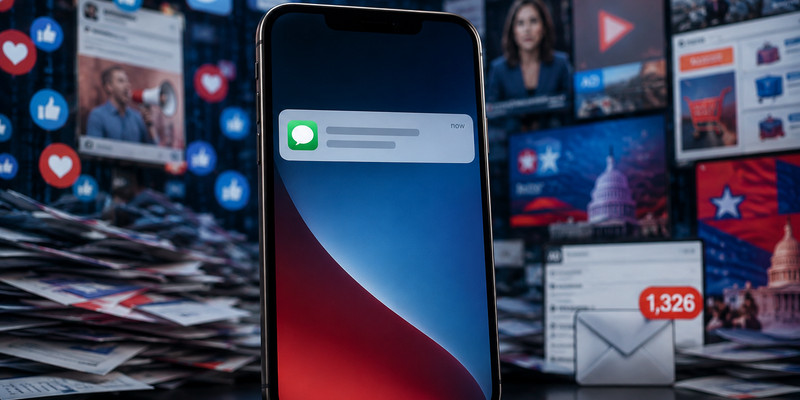
In a media environment defined by algorithmic gatekeeping, rising ad costs, and degrading third-party targeting, political campaigns are rediscovering one of the oldest digital channels available to them — and finding it outperforms almost everything else.
SMS is not new. But the strategic case for it has never been stronger than it is in 2026.
The Numbers Haven't Changed — They've Only Gotten More Relevant
The performance gap between SMS and every other outreach channel has been consistent for years. What's changed is how much it matters given the environment campaigns are operating in.
Infobip's 2026 SMS marketing benchmarks found that text message marketing delivers an open rate of 98% — nearly five times higher than email's typical 20% — with 90% of messages read within three minutes of delivery and response rates of 45% compared to roughly 6% for email. For a campaign trying to break through in a crowded digital environment where social media algorithms control what gets seen and email inboxes are increasingly filtered, SMS offers something no other channel reliably delivers: guaranteed visibility. A text message sits at the top of a voter's notification screen. It does not wait in a queue, get deprioritized by an algorithm, or land in a promotions folder.
Over 15 billion political texts were sent during recent election cycles — a volume that reflects not just enthusiasm for the channel but its proven ability to reach voters at moments that matter.
Why the Strategic Context Has Shifted
SMS has always had strong engagement numbers. The reason it is receiving renewed attention in 2026 is not the channel itself — it is everything happening around it.
Platform algorithms have become less predictable and more restrictive. Third-party cookie-based targeting is degrading. Paid social costs are rising. CTV inventory is tightening. In that environment, owned channels — lists and audiences that campaigns control directly, without depending on any platform's algorithm or any third-party data infrastructure — are becoming more valuable with every cycle. Campaigns & Elections notes that texting is no longer experimental in political campaigns — it is a standard line item in campaign budgets, sitting alongside digital ads and field programs because it reliably reaches voters where they actually look. That reliability is precisely what most digital channels are currently failing to provide consistently.
SMS also compounds in value when integrated with the first-party data strategy that campaigns are being pushed toward anyway. Every opt-in is a consented, owned contact — an asset that belongs to the campaign regardless of what any platform, browser, or data vendor decides next.
The Compliance Reality Campaigns Cannot Ignore
The performance case for SMS is strong. The compliance requirements around it are equally serious — and campaigns that treat them as an afterthought are creating significant legal and operational exposure.
Since February 2025, all major U.S. carriers block 100% of unregistered A2P — Application-to-Person — SMS traffic entirely. Messages from unregistered numbers do not get filtered or delayed. They are simply not delivered. Infobip's 2026 TCPA compliance guide found that TCPA class action filings spiked 283% in September 2025 alone — with 224 class actions filed in a single month and a 112% increase over Q1 2024 — and that a campaign sending 100,000 messages without proper consent could face legal exposure exceeding $150 million in a class action at $500 to $1,500 per message in TCPA fines. The compliance infrastructure is not optional, and it is not a one-time setup. Campaigns registered in 2023 and 2024 may need re-verification as carrier requirements have evolved, and outdated registrations can trigger filtering even for technically compliant messages.
The practical checklist before any campaign sends at scale:
- 10DLC registration through The Campaign Registry — required for all A2P messaging since February 2025, with a vetting process that takes up to 10 business days and requires resubmission if rejected
- Prior express written consent for all automated texts — generic "sign up for updates" opt-ins do not meet TCPA standards; consent must be specific to text messaging and documented
- Clear sender identification in every message — recipients must know which campaign is texting them
- Opt-out compliance — STOP instructions must be included and honored immediately, with Virginia's 2026 law now requiring opt-outs be honored for 10 years
What Effective SMS Strategy Looks Like in 2026
Getting registered and compliant is the floor, not the ceiling. The campaigns extracting the most value from SMS are thinking about the channel more strategically than blast-and-broadcast.
Campaigns & Elections notes that political SMS has largely solved the problem of sending at scale — but that reply management remains an underdeveloped capability for most campaigns. When a voter responds to a text, that interaction is an opportunity. Campaigns that treat incoming replies as an afterthought rather than a core part of their SMS operation are leaving some of the channel's most valuable engagement on the table.
The highest-performing SMS programs in 2026 are built around a few consistent principles: segmenting sends by voter type and engagement history rather than blasting the full list, timing messages around actionable moments — registration deadlines, early voting windows, GOTV pushes — rather than broadcasting continuously, and treating the SMS list as a relationship asset that compounds in value over time rather than a one-cycle deployment.
The Owned Channel Advantage
The broader shift happening across digital campaign strategy is a move toward channels that campaigns own and control — and SMS is among the most durable of those assets. An email list degrades. A social media following depends on an algorithm. An SMS subscriber list, built with proper consent and maintained with discipline, is a direct line to a voter that no platform policy change or cookie deprecation can disrupt.
In a 2026 media environment where every other channel is getting more expensive, more crowded, and more uncertain, that kind of reliability is increasingly hard to put a price on.